How a number is made
Every read agrees to the digit, or nothing is signed.
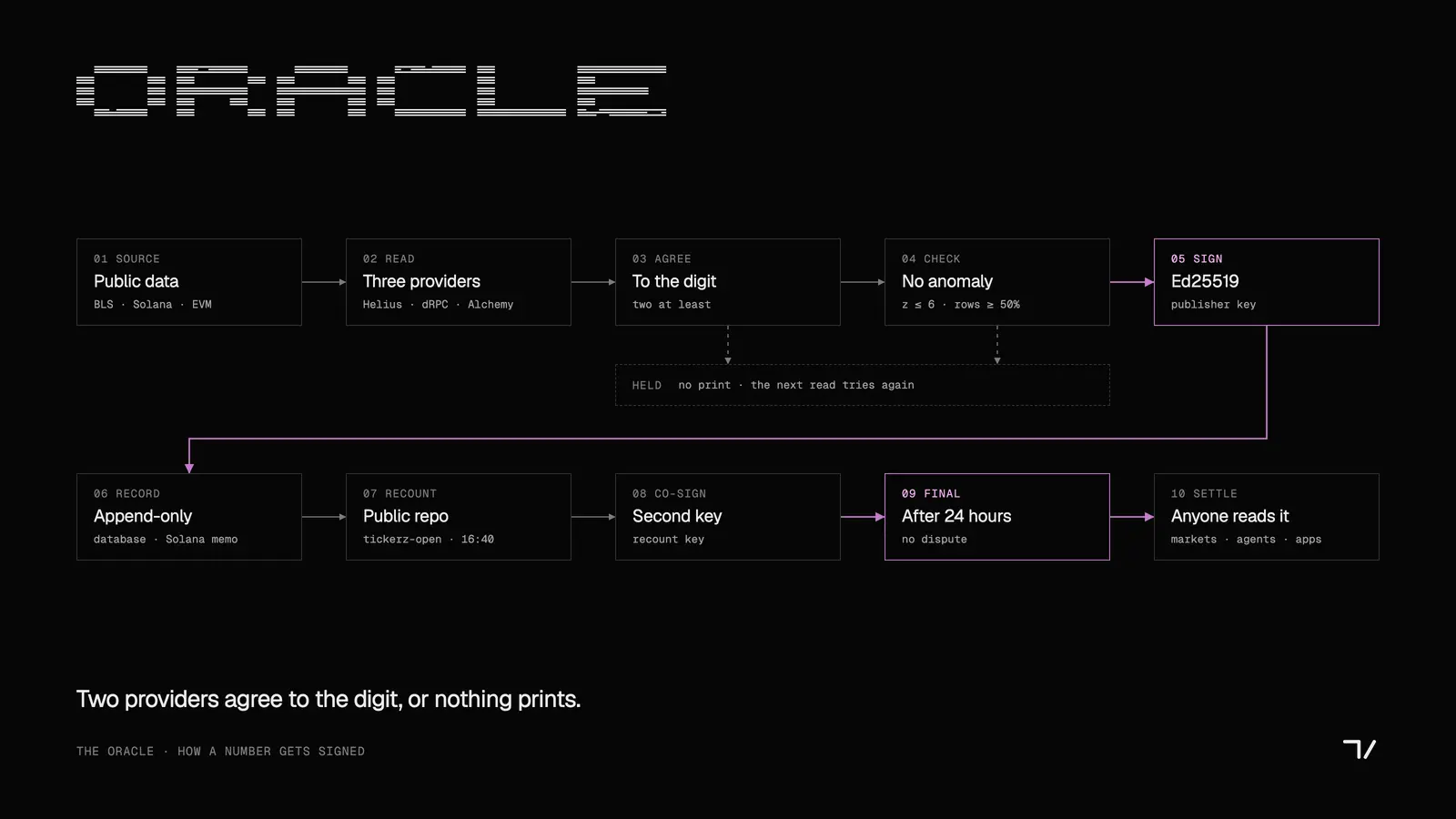
- Source. A public record: the Bureau of Labor Statistics, the Labor Department, a blockchain. Each index names one in its rule, with the clause of the source's terms that allows it. Data sources
- Read. The same period is read from each provider configured for the source. On Solana: Helius and Alchemy (dRPC is configured, but its free plan does not serve Solana). Official numbers: the Bureau's API and its flat file; for $LAYOFFS, the Labor Department's claims file.
- Agree. A chain count needs two providers whose terms allow it to return the same number, to the digit; close is not agreement, and a miss waits for the next read. An official number needs every read to equal the number as first published; a revised number is never signed.
- Check. A number more than 6 robust deviations from its own history, or a read with fewer than 50% of its usual rows, waits for one more read. A real day survives it; a bad file usually does not.
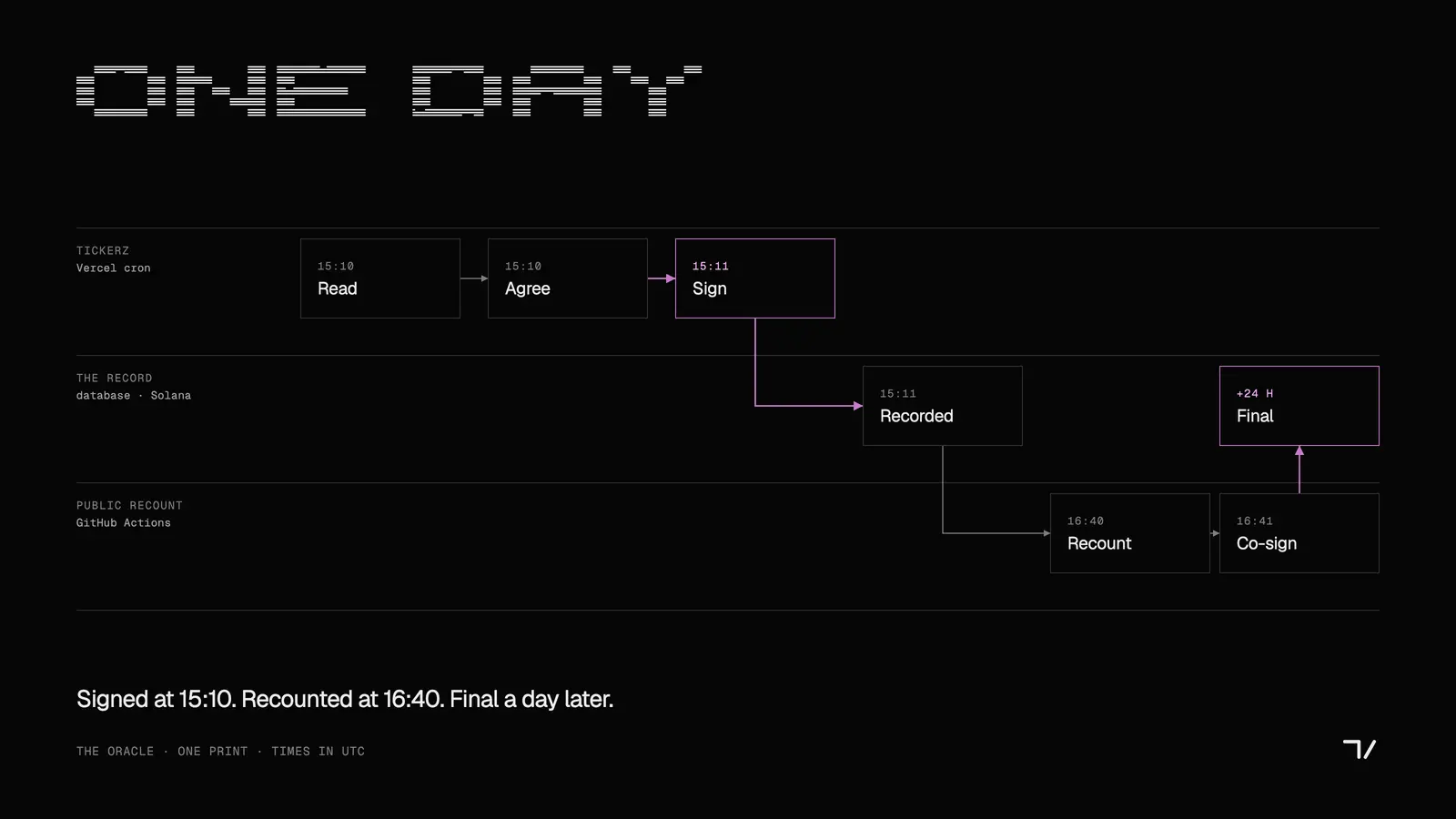
- Sign. The report (ticker, period, value, rule hash, the reads) is written as canonical JSON, hashed with SHA-256 and signed with the publisher's Ed25519 key. Daily at 15:10 UTC.
/api/indices/{ticker}/report - Record. The report goes into tables that only take new rows. Nothing is edited. A correction is a new report that names the one it replaces.
- Recount. A separate job in the public repository counts the same period again from the source, with its own code. Daily at 16:40 UTC. tickerz-open/oracle
- Co-sign. When the recount gets the same number, it signs the report's hash with its own key. When it does not, it files a dispute beside it. Both keys are in tickerz-signer.json.
- Final. A co-signed report with no dispute after 24 hours is final at the next oracle run (15:10 or 15:35 UTC).
- Read it. Anyone checks the hash and both signatures in the browser on Signed numbers, or reads the feed at oracle.tickerz.com.
- Months loaded as history. The Bureau's figures loaded on the day the index launched. Only a month captured at its release counts as first published, and only that number is signed.
- The unusual trading score. A statistical reading of how unusual a day is. Display only.
- Forecasts. The next number's likely range and how unusual the newest one was, from the Tickerz forecast engine, whose method is not published. Display only. Forecast
- Indexes without clean rights. Where a source's terms do not allow a market to settle on it, the print is shown and marked Display.
- The indexes that lead the board. The human, fringe, space and federal indexes are read, scored and timestamped every day. The oracle does not sign them yet, so none is offered for settlement.